Vulnerability scanning
vs. penetration testing
One tells you what is wrong. The other tells you what someone can do about it. You need both, and one does not substitute for the other.
A scanner finds weaknesses one at a time. An attacker uses them three at a time.
That is the whole gap. A scan is an inventory of what is known to be broken, item by item, scored item by item. A penetration test is a person putting those items together until they reach something that matters — and what they reach is rarely the sum of the parts.
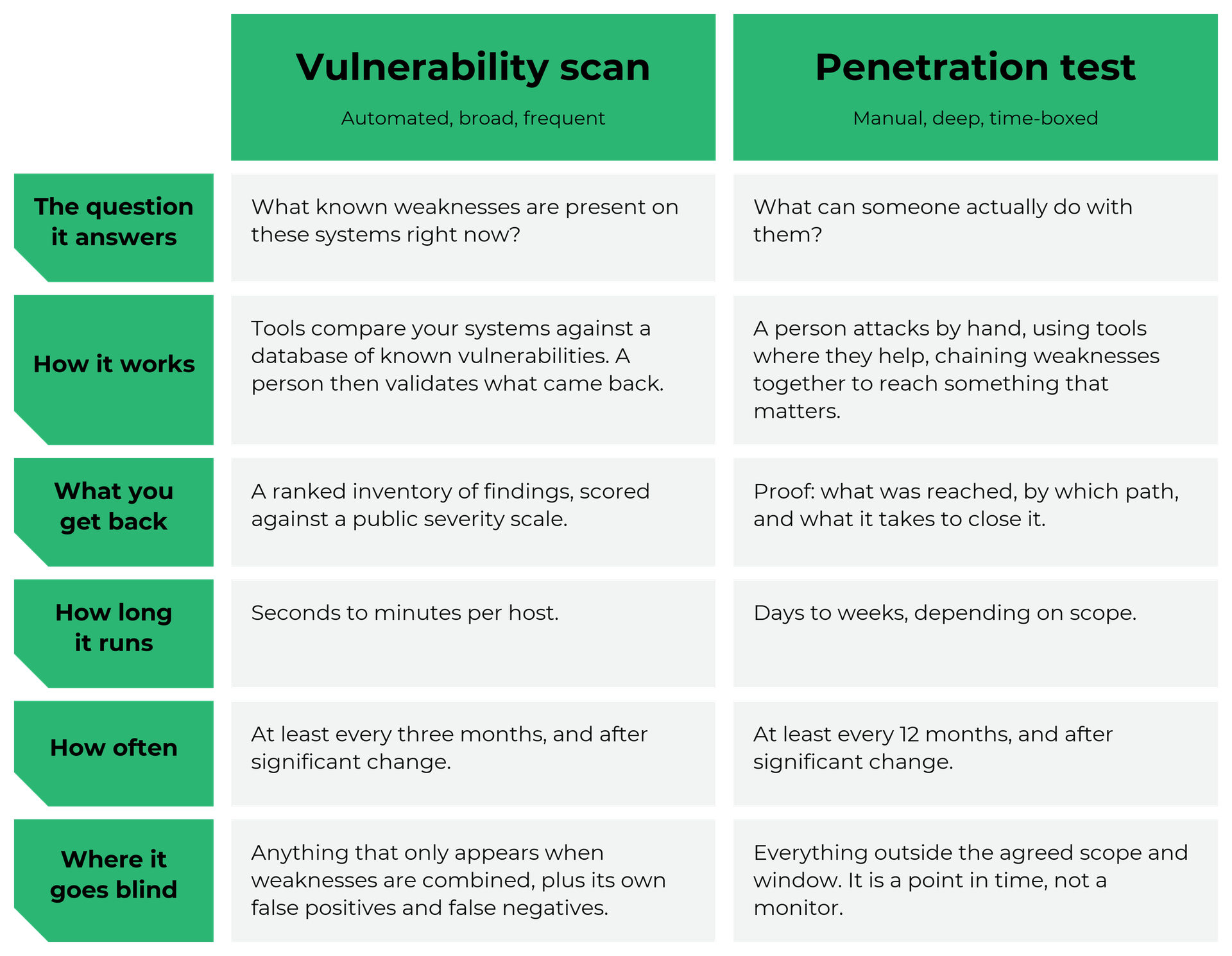
— SIDE BY SIDE
Two tools, two questions
The first five rows follow the structure PCI SSC itself uses to separate the two, in Penetration Testing Guidance v1.1, §2.1. That document predates PCI DSS v4 and uses the older requirement numbers; in v4.x, scanning sits at Requirement 11.3 and penetration testing at Requirement 11.4. The frequencies did not change.
Neither one tells you whether your team would notice an attack in progress. That is a covert exercise, scoped and priced separately.
Four terms used as if they were one
Most of the confusion in a security proposal starts here. It is worth asking a provider which of these they are quoting you.
Vulnerability Scan
Vulnerability Assessment
Penetration Test
Vulnerability Management
Do you need both?
Scanning is coverage
Testing is depth
OWASP's method needs at least two accounts to prove that one user cannot reach another's records; PCI's guidance expects application-layer testing to exercise every role and access type. Without credentials, you have bought a test of your login page.
A scanner rates each weakness on its own. Real compromise usually comes from a chain: a piece of information here, a permission that is slightly too broad there, a service that trusts the first two. Each link can score “low” and the chain can still end at your data — which is precisely the case NIST warns about.
A scanner checks whether a known weakness is present. It does not check whether one signed-in user can reach another user's data, whether a business process can be run out of order, whether a permission model holds under pressure, or whether three harmless findings form one path. Those are judgment problems. They need a person, and they are where most real incidents live.
Two things make that list usable: removing what is not real — false positives are a documented weakness of every scanner, and NIST says results need an experienced person to interpret them — and re-ranking what is left by what can actually be reached and exploited where you have it.
NIST SP 800-115, Technical Guide to Information Security Testing and Assessment, §4.2 (vulnerability scanning, false positives, combinations) and §5.2 (penetration testing) — nvlpubs.nist.gov
PCI SSC, Information Supplement: Penetration Testing Guidance v1.1, §2.1 — pcisecuritystandards.org. Guidance, not a standard, and written against PCI DSS v3.2; in v4.x the normative text is Requirement 11.3 for scanning and Requirement 11.4 for penetration testing.
NIST CSRC Glossary, vulnerability scanning: “a technique used to identify hosts/host attributes and associated vulnerabilities.”