Black-box, grey-box, white-box
Three names for a single variable: how much the tester knows when the clock starts. What each one buys you, where each one is blind, and how to choose in about two minutes.
You are not buying three grades of rigor. You are buying a fixed number of expert days — and the only thing that changes between black-box, grey-box and white-box is how much the tester knows when the clock starts.
Not a vulnerability scan
Not a detection exercise
Not a guarantee
— FIRST, THE BASICS
What a penetration test actually is
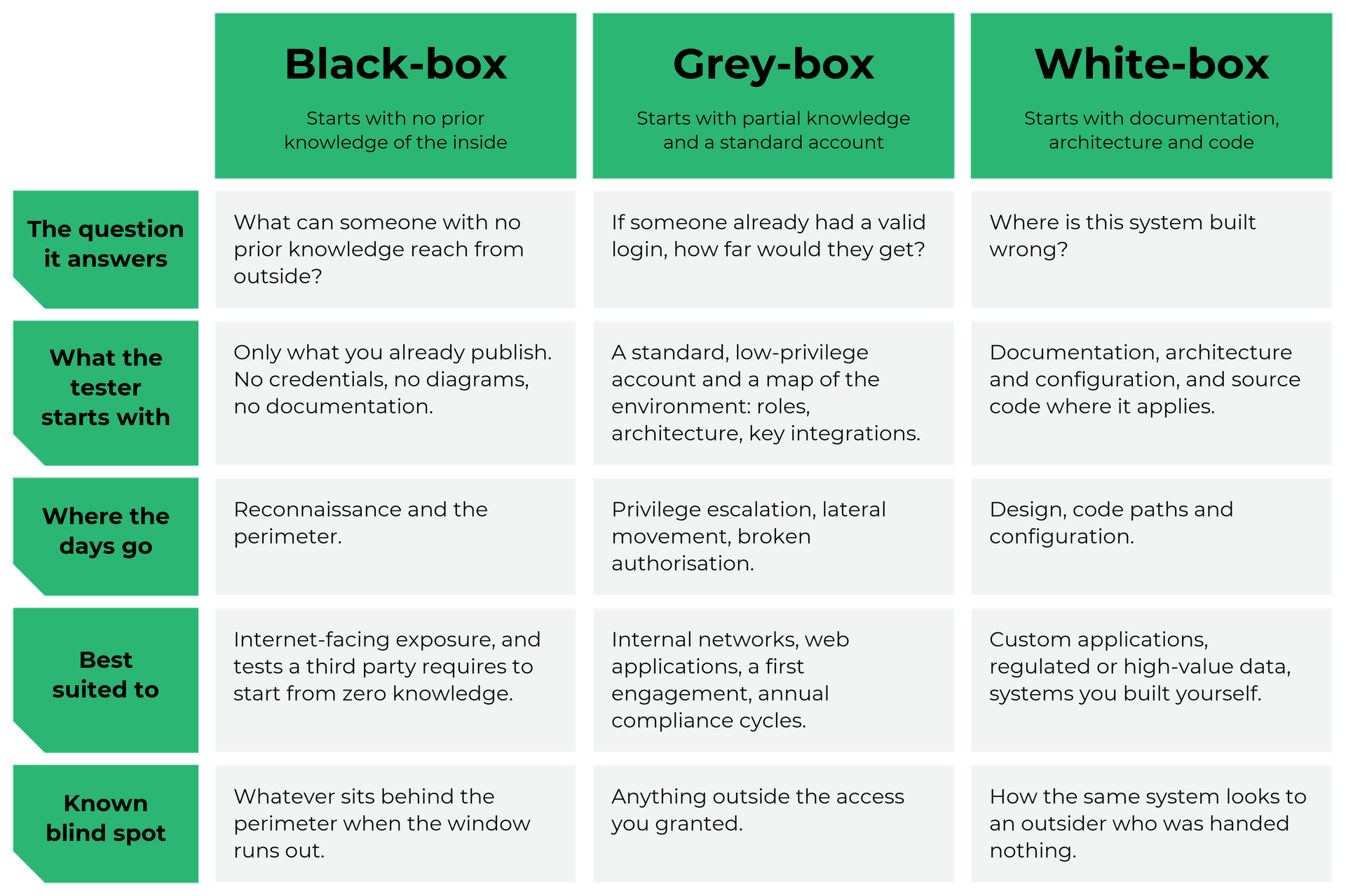
— The comparison
Three names for one variable
How much the tester knows (black, grey or white box) and how much privilege they start with (unauthenticated, standard user, administrative) are two separate scoping decisions. We state both in writing.
None of the three measures whether your team would detect the attack. That is a covert engagement, scoped and priced separately.
Terminology: NIST records these as black box, gray box and white box, defined by how much knowledge the tester has of the internal structure of the system. PCI SSC uses the grey-box spelling and notes that PCI DSS tests are typically performed as white-box or grey-box assessments. The spelling varies; the level of access it describes should not.
Three decisions get confused with one
How much the tester knows
Where the tester starts
Whether your team is told
Which one should you buy?
Buying your first test and none of those lines settles it? Grey-box, overt, external and internal, authenticated.
It is the approach that turns a fixed budget into the largest number of findings you can actually act on.
PCI DSS
Requirement 11.4 asks for internal and external testing at least every twelve months and after significant change, a documented methodology, remediation of what is exploitable with a retest, and segmentation validation. PCI does not mandate a color of box; the Council's own guidance notes that PCI tests are typically performed as white-box or grey-box assessments. Service providers revalidate segmentation every six months, not every twelve.
SOC 2
The Trust Services Criteria never name penetration testing as a requirement. CC4.1 asks for ongoing and separate evaluations, and a point of focus lists penetration testing among them — in practice, the auditor expects one. Grey-box and authenticated, against the product your customers actually use.
HIPAA
The HIPAA regulation (§164.308(a)(8)) currently requires periodic security evaluations. The proposed rule for 2025 seeks to establish a strict requirement that would include annual penetration testing and semi-annual vulnerability scanning. Specifically, the proposal indicates that these must be "grey-box" tests applied to all systems that touch Electronic Protected Health Information (ePHI).
— THE FOUR QUESTIONS WE ARE ACTUALLY ASKED
Answered, not just raised
OWASP's method needs at least two accounts to prove that one user cannot reach another's records; PCI's guidance expects application-layer testing to exercise every role and access type. Without credentials, you have bought a test of your login page.
If the question is “would we notice?”, that is a detection-and-response exercise and should be scoped and priced as one. The middle path is the one PCI's own sample rules of engagement describe: leave logging and alerting fully on, remove only the blocking, for the test window alone, agreed in writing before anyone starts.
It also measures your team's response as much as your technology — and it measures our testers against a calendar a real attacker never has. If you want to know how bad it could get and whether you would see it, commission that deliberately. If you want to know where you are weak so it can be fixed, an informed test covers far more ground in the same hours.
Real attackers reach the same starting line by other means. In Verizon's 2026 report, exploitation of a known vulnerability is now the most common way in at 31%, and credential abuse appears somewhere in 39% of breaches. OWASP is blunter still, calling testing with no documentation and no source code an assurance activity that “should be actively discouraged” — much as a financial audit with no access to the books would be.
— BEFORE ANYTHING STARTS
What we put in writing
The scope
The approach
What we need from you
The testing window
The escalation path
The deliverable
The honest limit
A penetration test establishes what an attacker could do, with a defined level of access, inside a defined scope, over a defined period. It is evidence, not insurance — as the UK's NCSC puts it, a test can only confirm that your systems were not vulnerable to known issues on the day they were tested.
What we commit to is the part that can be committed to: scope agreed in writing before work begins, a documented methodology aligned to NIST SP 800-115 and OWASP, and findings ranked by what can actually be exploited rather than by a scanner's severity label.
A question worth asking every provider. Before you sign, ask them to put in writing: which of the three approaches they are proposing, where the tester starts, whether your team will be told, what is in scope and what is explicitly out — and whether a retest is included.
Nothing starts on a verbal scope.
NIST CSRC Glossary — black box, gray box, white box testing
PCI SSC, Information Supplement: Penetration Testing Guidance v1.1 — pcisecuritystandards.org. Guidance, not a standard; PCI DSS v4.0.1 Requirement 11.4 is the normative text.
OWASP ASVS 4.0.3, Using the ASVS · OWASP WSTG v4.2, WSTG-ATHZ-04 · OWASP Top 10:2025, A01 Broken Access Control
CREST, A Guide to Penetration Testing (2022) · NCSC UK, Penetration testing and Terminology: it's not black and white
Verizon, 2026 Data Breach Investigations Report · Saltzer & Schroeder (1975), open design · AICPA Trust Services Criteria CC4.1 · HHS OCR, HIPAA Security Rule NPRM, 90 FR (6 January 2025)